
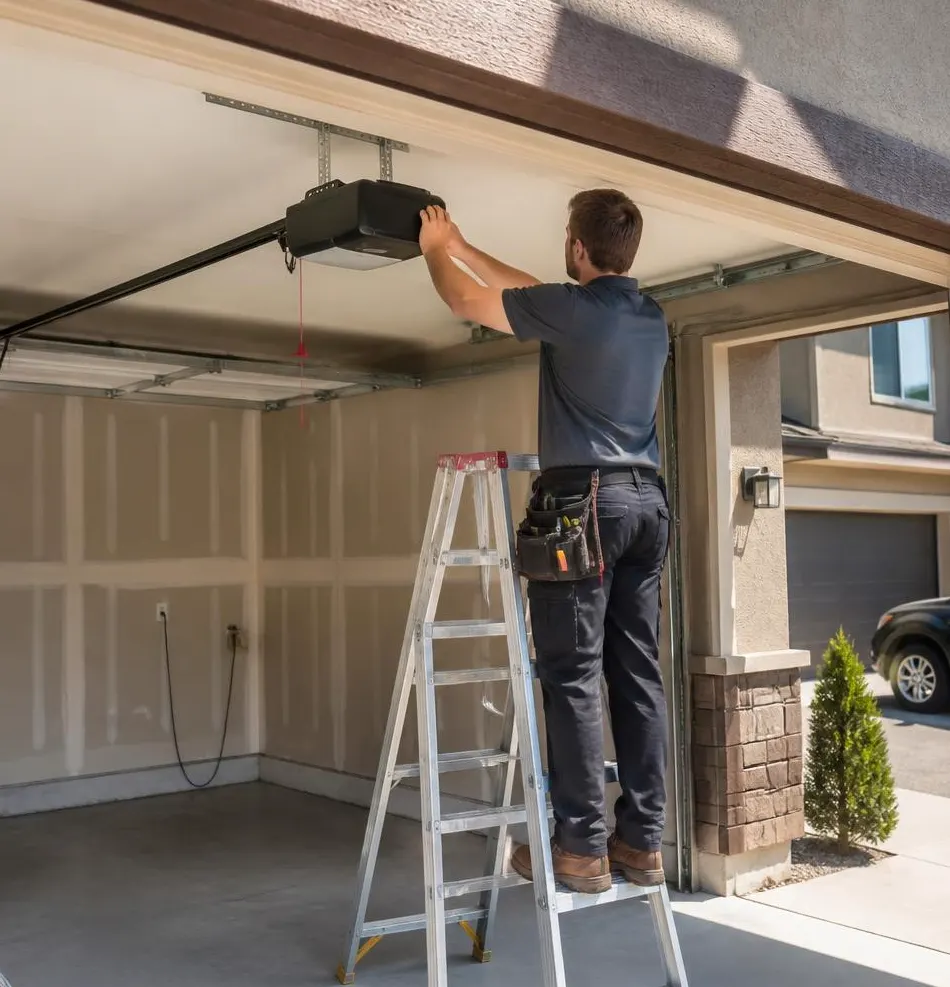
What a Technician Sees on These Calls
A common service call around here starts with "my opener just died" or "it's the second opener in three years." Nine times out of ten, the opener itself isn't the real problem. The door is out of balance, so the opener's motor has been doing the lifting work that the springs are supposed to do. By the time the gears strip or the circuit board burns out, the springs have usually been drifting out of calibration for months. In this climate, that drift happens faster than people expect — humidity and salt air corrode spring coils, heavy rain swells wood panels and track hardware, and the wind-load-rated doors common in this area are simply heavier, which means more stress on a spring that's starting to weaken.
Tools You'll Need
- A stepladder (for tall garage doors)
- Work gloves
- A pencil or piece of tape to mark door position
- A second person to help watch, though not required
You won't need any wrenches or spring tools for this test — and that's the point. This is purely an observation test.
How to Test Garage Door Balance
- Close the door completely. Start from a fully closed position so you have a consistent baseline.
- Locate the manual release cord. This is usually a red rope hanging from the trolley on the opener rail.
- Pull the release cord to disconnect the opener. You should hear or feel the trolley disengage from the carriage. The door is now running purely on its springs, not the motor.
- Lift the door manually to about waist height. Lift smoothly, not with a jerk.
- Let go and watch what happens. A properly balanced door will stay put, or drift down only an inch or two before settling.
- Repeat at a few different heights — a third of the way up, halfway, three-quarters. Mark each spot with tape or pencil so you can compare.
- Reconnect the opener by pulling the release cord again (or using the door's manual lock lever) and running the door through a normal cycle to confirm it re-engages correctly.
Reading the Results
- Door stays in place or drifts slightly: balance is good.
- Door sinks to the floor on its own: springs are weak or worn, and the opener has been compensating by working harder on every cycle.
- Door shoots upward on its own: springs are over-tensioned, which puts excess strain on the opener's reverse mechanism and can be a safety hazard.
- Door feels heavy or uneven side-to-side: one spring (on a two-spring system) may have failed or weakened independently, which also throws off the opener's travel limits.
What This Does to Your Opener Over Time
An opener is built to nudge a balanced door the last few inches of travel, not to haul the full weight of the door up and down. When the springs stop pulling their weight, the motor draws more current every cycle, the drive gear and belt or chain wear faster, and the opener's limit switches get knocked out of adjustment as the door struggles to reach full open or full close. This is how homeowners end up replacing openers every couple of years instead of every decade.
Where to Draw the Line
Testing balance is homeowner territory. Adjusting it is not. Torsion springs store enormous tension and adjusting them requires winding bars and specific technique — this is not a DIY repair, especially on the heavier wind-load-rated doors used throughout Okaloosa County. If your test shows an imbalance, that's the point to call in a technician rather than reach for a ladder and a wrench.
When to Call Crestview Garage Door
If your door fails the balance test, we'll check spring tension, inspect for coastal corrosion or humidity-related swelling in the tracks, and recalibrate everything so the opener goes back to doing light work instead of heavy lifting. This usually falls under Spring Replacement or a Garage Door Maintenance & Tune-Up, depending on how far things have drifted. Catching it early is a lot cheaper than replacing an opener that never needed to fail in the first place.
If your garage door in Crestview, FL feels heavy, uneven, or louder than it used to be, give us a call before it takes the opener down with it.